

The old adage is people don’t leave jobs, they leave managers. The Office, both the UK and US versions, detail what it’s like to work with an ineffectual manager. There are many cartoons like Dilbert that lampoon corporate life.
I think this comes down to one main point which is that we are calling Managers by the wrong title. They aren’t there to manage, they are there to help. They should be called Helpers, not Managers. This can be explained by three ideas, Goodhart’s Law, the Peter Principle, and that we are not children.
Economist William Goodhart created an adage called Goodhart’s Law, which states “that when a measure becomes a target, it ceases to be a good measure”. Goals are great and it’s appropriate to measure your performance against those goals but the devil is in the detail.s
The NHS tried to improve patients waiting times by requiring them to all be seen within four hours. This makes sense. If patients can be seen sooner then the hospital is working efficiently. This leads to some positive outcomes, but, some hospitals in order to hit their targets were making patients stay in ambulances until they were ready to see them.
The measure in isolation doesn’t mean anything. It needs to always be seen in context with what the measure is meant to stand for. If the Manager just managers based on the measure then you get unwanted outcomes.
Another idea is the Peter Principle by Lawerance Peters. The concept is that people rise to the level of their incompetence. People get promoted based on their performance rather than their aptitude for the new job and so hit a ceiling where they are in the wrong role for their ability.
The classic example is the Sales Superstar. Smashing out all of the sales targets. The assumption is that because they are good at sales they will be able to lead the sales team. The obviously failing in logic is that being good at sales has no relationship to leading a team. So now the Sales Superstar is in a management role which they don’t have the skills for, so they are unhappy. They start to micromanage the sales team because they are good at sales and not leadership. The outcome of these actions is that the whole sales team does worse and no one is happy.
This isn’t the now managers fault. This is failing of putting people in positions to succeed. We have to address that people and systems are not perfect and create imperfect outcomes. The issue is that if they saw themselves as a helper and not a manager maybe some of these issues can be overcome.
The final point is that we are not children. The idea is that you need someone hovering over you to do your work is very demeaning. Presentism is huge now that people feel the need to be at work rather than actually do work. Again the difference between what is important and what is measured.
If you have staff that need Big Brother over their shoulder to do their work you have either hired the wrong people or you have a terrible culture of fear in your organisation.
This is where rebranding managers as Helpers will change everything, well hopefully something. Their job isn’t to manage a measure, their job is to help the staff be as great as they can. If you only focus on the measures then the team isn’t going to get better. If you focus on improving your team, you will get the results.
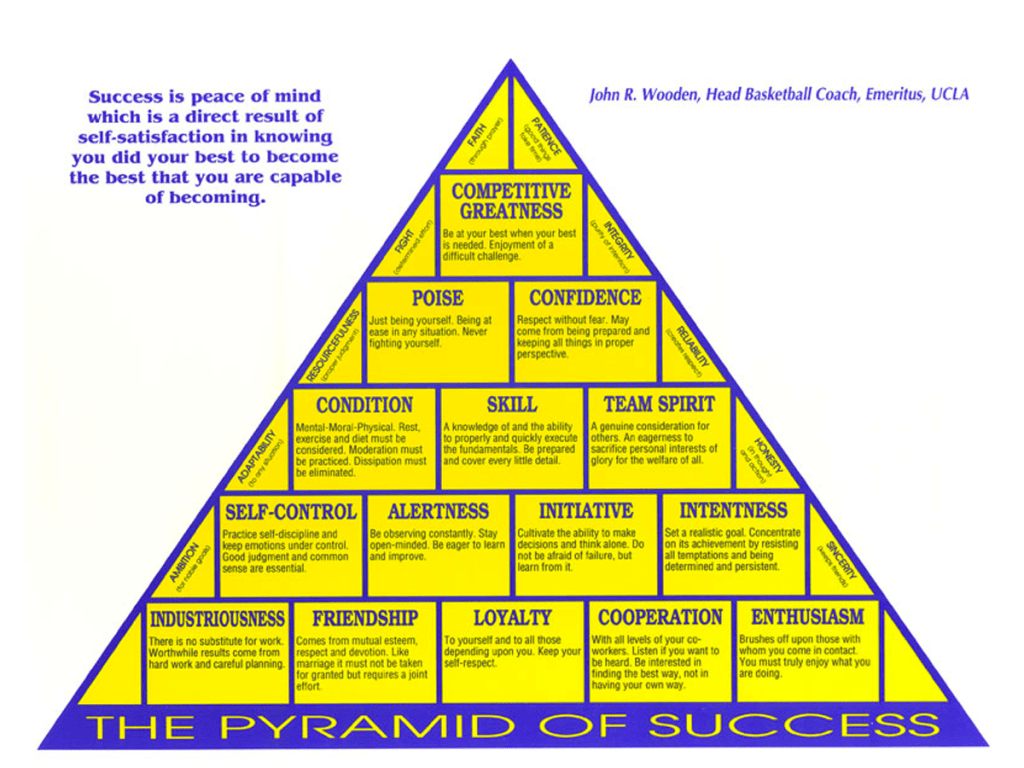
Legendary UCLA men’s basketball coach John Wooden created the Pyramid of success that has been used by many winning teams and organisations. It focuses primarily on the internal, your own team, choices, and actions. You have no control over the outside world, but internally you have all of the control.
During my MBA, the professor of Organisational Behaviour said there is a difference between being a transitional manager and a transformation leader. I loved this expression but I think it’s slightly wrong. I think anyone can be a leader within an organisation. A leader is not a title but an action. But a transformation Helper, that is one hell of a title.
 Luke McMeeken-Ruscoe