
Today, there are a million and one frameworks for success. Everyone has a theory on how things work. No frameworks are good or bad, some are more effective, and like with any tool it is more about how you use it.
To explain how to use tools successfully in your workplace we obviously go straight to
SABRmetrics
The book Moneyball: The Art of Winning an Unfair Game which was later turned into a movie with Brad Pitt, details the story of Billy Beane, who in 2002 as the Oakland Athletics General Manager, used a new form of analytics to assess his baseball players.
Sabermetrics was a term created by the Society for American Baseball Research, originally called SABRmetrics, to empirically analyze baseball. They tried to explain the game with numbers rather than with feelings.
The idea was not well-received by basically anyone on the baseball world.
One of the earliest books was by Earnshaw Cook in 1964 called Percentage Baseball. It wasn’t until 1977, when Bill James started to write Baseball Abstracts that people started to give some legitimacy to the ideas of sabermetrics.
Then some 25 years later, Billy Beane ran with the idea and the rest is history, analytics took over baseball, and then it started to infiltrate other sports like my beloved basketball.
The Stats Attack
The analytics nerds also hit basketball. The basic premise is the expected points return of any shot.
The expected return of a 2-point shot that is being shot by a player shooting at 50% is 1 point. They will make them half the time and so will get two points every time they shoot twice so 2 divided by 2 is 1.
If the same player shoots 33% from the 3-point line, their expected point value for each 3-point shot is also 1.
As a player improves their 3-point shooting above 33% their expected point per shot increases, which makes 3-pointers more valuable.
The image below shows the change in shooting frequency between the Michael Jordan era and what is happening now.
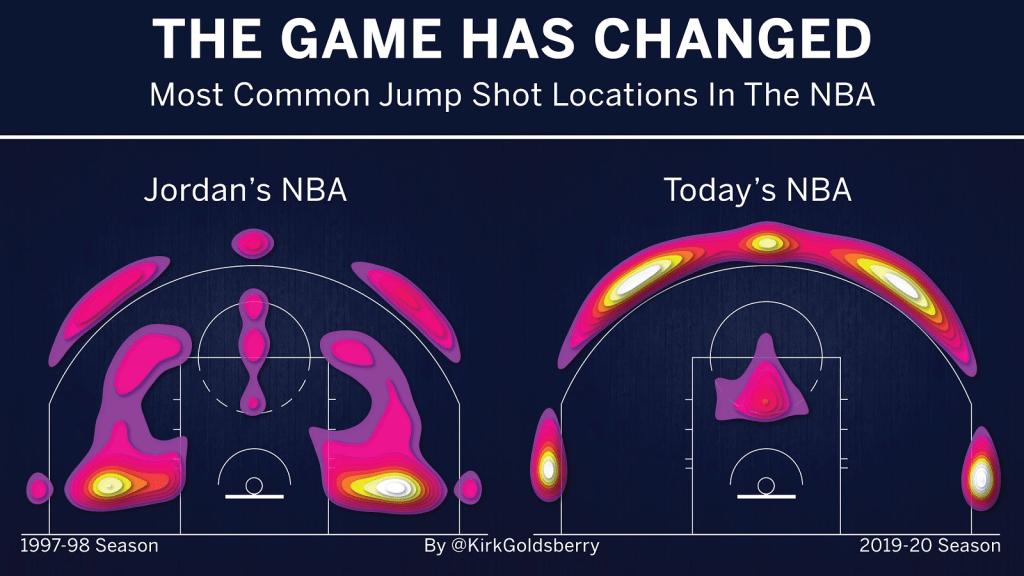
The math all works out, the trouble is that there is nuance to everything and sometimes the math doesn’t math.
Using a Framework
The trouble with the world of analytics is that it requires you to understand analytics. The framework is looking at shooting percentages which will then inform your shot selection.
It is not telling you to only shoot threes, it is saying to shoot shots with the highest expected return.
If you shot above 33% from behind the 3-point line then shoot more 3-points.
However, the key point here is that if you don’t shoot above 33% then you probably shouldn’t shoot many 3-points.
And you know who doesn’t shoot about 33%, most basketball players.
Most people who play basketball don’t shoot that well and that can inform you on how to use frameworks within your team.
Team of Teams
In one of my former jobs, they tried to implement Team of Teams.
It is an interesting idea. Within the greater team you have a lot of different skill sets. This framework suggests you combine people from different teams into specific teams to solve specific projects.
Sounds pretty straightforward.
The challenge is that the nuance of the whole thing is that you are meant to find skills that work with the specific project and put those people together.
My workplace just put anyone together.
And, wouldn’t you know it, the projects didn’t come to be much because the team didn’t have the skills to solve the project.
There was nothing wrong with the tool, there was a problem with the application of the tool.
Don’t shoot more 3-pointers because you see another team shoot 3-pointers, understand why they are shooting them and apply that thinking to your own team.
Newsletter
Thanks for Reading. If you want more ideas about strategy and leadership every week, enter your email below and join the team.
 Luke McMeeken-Ruscoe